

September Is National Literacy Month
Delaware Public Media, the Delaware Literacy Alliance, and Delaware Public Libraries have collaborated to bring to together First State Literacy Resources in celebration of national literacy month.

Resources From Our Partners
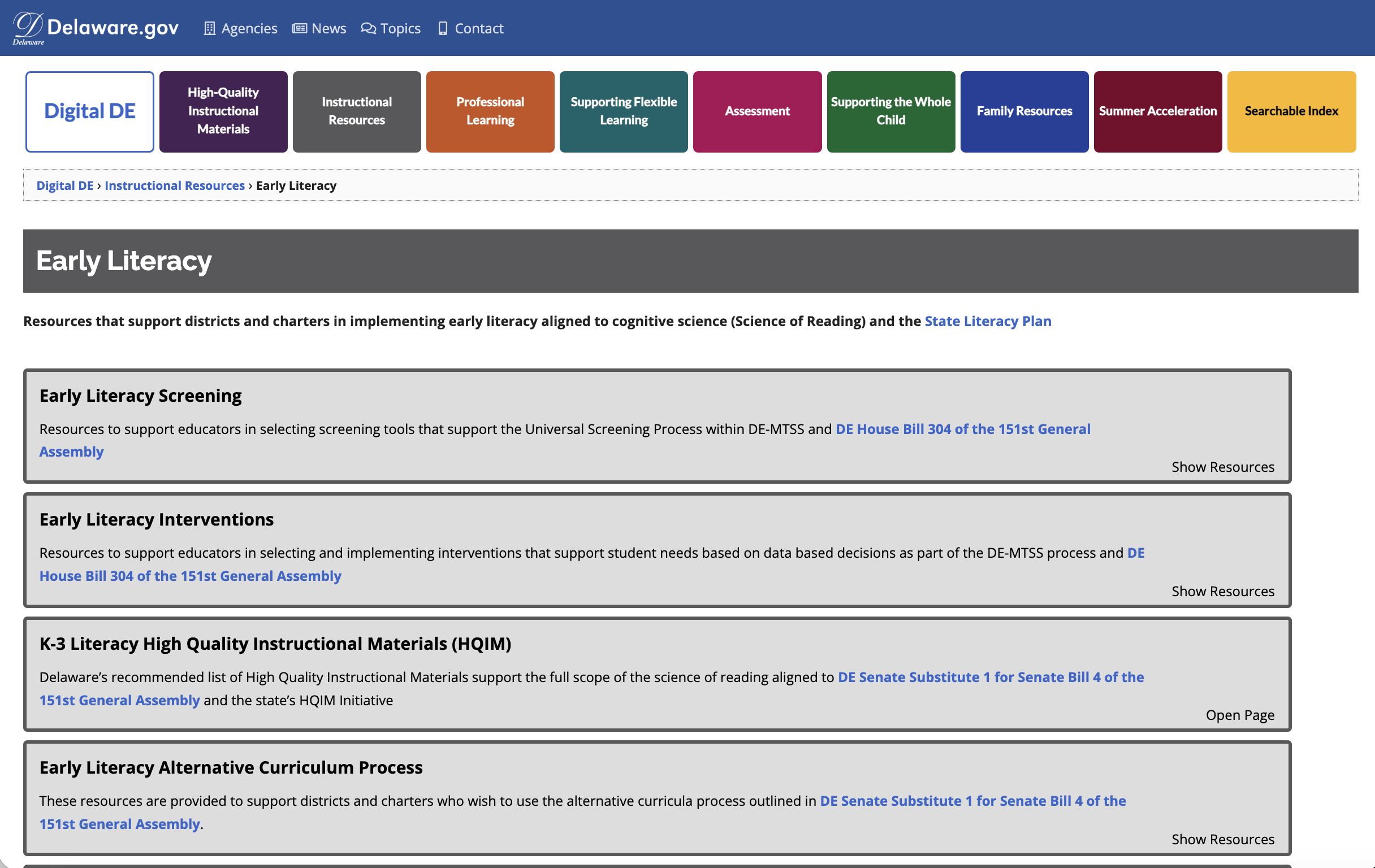
Early Literacy Resource Hub
DE Libraries Event Calendar
DOE Early Literacy Plan
DE Reads Toolkit

WHAT THE RESEARCH TELLS US
The Science of Reading & Why It Matters
The Science of Reading is a broad body of research from fields including cognitive science, neuroscience, psychology, linguistics, and education. It helps us understand how reading develops and which approaches are most likely to help students become skilled, confident readers. This research supports explicit, systematic instruction in the foundational skills students need to read successfully, including phonemic awareness, phonics, fluency, vocabulary, language, and comprehension. But the Science of Reading is not a single curriculum, program, or teaching method. It is an evolving evidence base that should guide decisions about instruction, materials, professional learning, and student support.
For school boards, understanding the Science of Reading is about governance, not classroom instruction. Boards create the conditions for strong literacy outcomes through decisions about priorities, resources, professional learning, accountability, and implementation. Their role is to ask whether the district’s literacy strategy is evidence-based, whether educators have the support to implement it well, and whether student data shows that the strategy is working.

A STATEWIDE PRIORITY
Delaware has made early literacy a central part of its vision for student success.
The Delaware Department of Education’s 2025–2028 Strategic Plan identifies Early Literacy Success as a priority within its Great Teaching and Learning building block. The state has set a measurable goal: increase Grade 3 reading performance on the statewide assessment from 38% to 53% by June 2028.
Secretary of Education Cindy Marten introduces the plan with a simple commitment: “Start with Students. Build for Impact.” The plan emphasizes measurable outcomes, accountability, evidence-based materials, professional learning, stronger use of student data, and coordinated support for learners. First State Educate’s literacy initiative supports that statewide direction by focusing on one essential part of the system: the governance decisions that help turn literacy goals into sustained action.
Delaware's statewide reading proficiency has reached a 27-year low. School boards control the decisions that determine whether literacy interventions succeed by approving staffing, budgets, and accountability structures, yet most board members receive no governance training.
THE REALITY
First State Educate and the three Delaware school districts are stepping forward to demonstrate how disciplined board leadership translates directly to stronger reading outcomes for students.
OUR SOLUTION
THE GOAL
Increase 3rd grade reading proficiency by 5% each year in participating districts.
This pilot demonstrates that when boards are trained, supported, and held accountable, student outcomes improve. The goal is measurable, public, and tied directly to governance decisions.
A three-phase model for governing for results
HOW IT WORKS


Three districts. One shared commitment.
PARTICIPATING DISTRICTS
Christina, Colonial, and Red Clay school districts are the first to participate in this pilot, each with a public, measurable literacy target and a board-superintendent team trained to govern for results.


VOICES FOR LITERACY
Why literacy matters from leaders across our communities
Literacy affects far more than a student’s performance in English language arts. It shapes how young people learn, communicate, solve problems, participate in their communities, and pursue future opportunities. We asked school board members and community and governance leaders to share what literacy means to them and why strengthening reading outcomes matters for Delaware’s students.
“Literacy is far more than the ability to read and write, it's the foundation for opportunity, critical thinking, and lifelong learning… It is one of the greatest equalizers we can provide to every child.”
Jeffrey T. Benson Jr., DBA
“Literacy is the foundation for every child’s success. As a school board member, I believe every student deserves the skills to read, learn, communicate, and build a successful future.”
Jose Matthews, Red Clay
“Literacy is the foundation for confidence, opportunity, and lifelong success. As a school board member, I believe ensuring every child becomes a strong reader is one of the most important commitments we can make, because when students can read, they can learn, lead, advocate for themselves, and shape their own futures.”
Celita Cherry, Christina
“Literacy matters to me because reading is how we explore and understand the world around us. When we give students a strong foundation in reading from the very beginning, we’re setting them up for success not just in the classroom, but throughout their lives.”
Britney Mumford, Appoquinimink
“Today, only about 4 in 10 Delaware third graders are reading on grade level, and national research shows that students who are not proficient readers by the end of third grade are four times more likely not to graduate from high school on time…When more students become strong readers, we put more of them on a path toward graduation, college, career training, and good-paying jobs. Improving literacy is an investment in our students and in the future of our entire community.”
Donna Johnson Geist, Capital
“Literacy is more than the ability to read and write. It can build confidence, open pathways to success, and give individuals constructive ways to express themselves“
Kristen Bruce, Brandywine
“Literacy opens the door to every possibility. As a school board member, I believe our greatest investment is giving every child the power to read, the confidence to dream, and the opportunity to write their own future.”
Yanelle Powell, Milford
“As a farmer, I’ve learned that basic literacy—reading, writing, and math—is just as essential as good soil and steady rain. Farming today is no longer powered only by the strength of your back; it demands the sharpness of your mind.
Jeffrey G. Allen, Laurel
“Literacy gives our students opportunities and dignity. Literacy opens doors that would otherwise remain closed for some. Giving a student the tools to read not only strengthens our schools, it strengthens our whole community. “
Patty Maul, Cape Henlopen
“As a school board member, literacy is one of the most powerful foundations we can give our students. Strong reading and comprehensive skills open the door to learning, building confidence, and preparing students for success in life. When we invest in literacy, we invest opportunity, every student deserves the tools to read, learn, dream and achieve.”
Dawn Green, Colonial
“Literacy is the foundation of learning and self-expression. The ability to read, write, comprehend, and communicate supports all careers and pathways, but perhaps more importantly, provides students with the skills they need to develop and communicate their own ideas.”
Robert Sebastiano, Smyrna
Whether you lead a district or invest in Delaware's future, there's a role for you in this initiative:
GET INVOLVED

